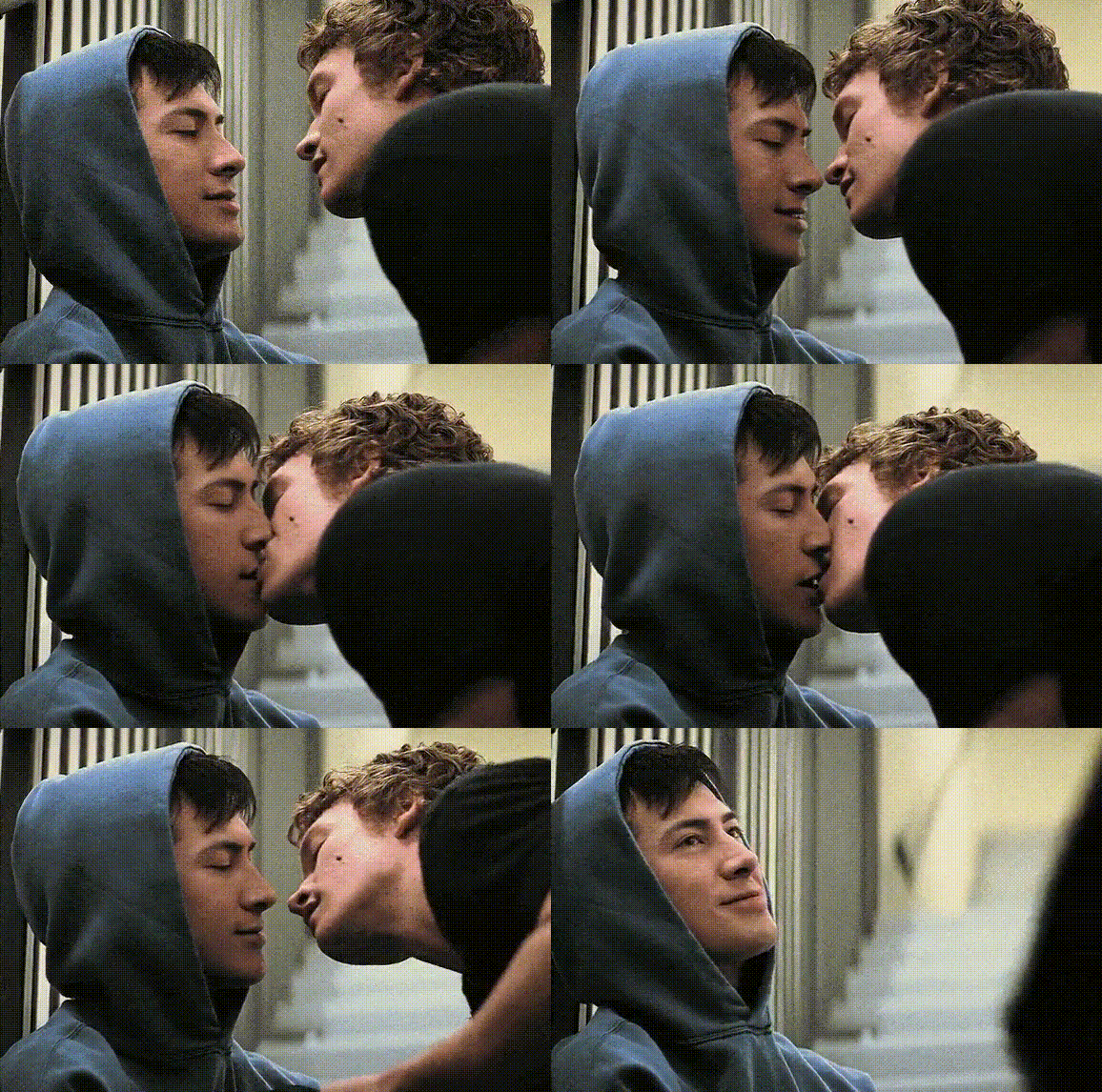
Heated Rivalry is basically an expert’s guide about how to tell intimate stories.
Unless you live under a very mediaphobic rock, you have probably heard at least a mention of Heated Rivalry recently. This TV show, which focuses on the love story of two queer hockey players – the bisexual Russian Ilya Rosanov (Connor Storrie) and gay Canadian Shane Hollander (Hudson Williams) – is one of the biggest surprises of 2025. The six-episode romance, made by the Canadian streaming service Crave and picked up right before it aired by HBO Max, dropped in the no man's land of late November, usually a time reserved for holiday fare and Oscar movie releases. It vaulted almost instantly to the top of HBO's "Most-Watched" list, and then became one of the most-watched series on streaming, period.
The show is based on a book series by author Rachel Reid, a queer romance author who specializes in hockey romance, which, yes, is a thing. Somehow it has managed to subvert the media machine, building its following largely through social media and word-of-mouth. This is a big fucking deal. All-knowing algorithms, combined with the consolidation of virtually every industry, have made it damn hard to break into the mainstream without heavy corporate support, and Heated Rivalry did not have any of that. In the last couple weeks, every possible mainstream media outlet has scrambled to acquire the Heated Rivalry stars, whether it is Jimmy Kimmel on The Tonight Show, CNN dropping an interview with Hudson Williams into its mid-day news, or locking them down to present at the Golden Globes–an awards show they can not be nominated for, by the way, because the show was made in Canada and released past the date to qualify.
This current media storm is a desperate attempt to climb on the bandwagon, but it obscures the real story about how this intensely subversive show found its audience. Somehow, Heated Rivalry fucked with all those attempts at algorithmic control, largely popularized by its audience of faithful romance readers and queer creators, and now it is officially viral.
If you are new to Heated Rivalry, here are the basics. The plot is fairly simple: Over a number of years, Shane and Ilya hook up in hotel rooms and stage secret rendezvous while slipping and sliding into love. The show indulges in a slew of tropes familiar to romance readers: enemies-to-lovers, secret relationship, slow emotional burn. There's even a touch of a rake/ingenue dynamic, as Ilya (who tells Shane in their first hook-up, "I like trouble") is charming but sharp-edged, and Shane presents as awkward, overachieving and pure of heart. The leads are attractive and have incendiary chemistry, the show is absorbing and beautifully made, and the story is sensitively told.
A lot of the discourse about Heated Rivalry has focused around the semi-explicit gay sex in the show, which mostly happens in the first two episodes while Shane and Ilya are still trying to keep their relationship surface-level. Is the idea that sexual intimacy can develop before emotional intimacy so strange? The pearl-clutching seems extreme to me, but I wonder if some of it is because of how skillfully the show depicts intimacy in general, and specifically between two men, a type of intimacy we do not see often.
The sex may be the honey that draws people in, but I don't think that's what is keeping them there. It's the little touches that stick with me, the way the show builds romantic tension, flirting that becomes true human connection. Shane kissing Ilya's forehead as they lie in bed together post-sex. Shane and Ilya communicating with shoe nudges during a press conference, a gesture that is later repeated when Shane and Ilya come out to Shane's parents. Ilya's hand on Shane's throat when he pulls him in for a kiss, assertive but not violent.
After Shane and Ilya have penetrative sex for the first time, the shot cuts to them in a stairwell, Shane holding Ilya's jacket to his chest as Ilya laces up his shoes. Hey, remember when I made you come hands-free? Ilya snarks. Is good trick. Shane looks up at him with hearts in his eyes and tells him to go fuck himself in a tone that means I love you. Ilya kisses him slowly and gently, a kiss that means I love you too.
We didn't even kiss, Shane types out and erases on his phone after one of their hookups that is plenty spicy but leaves them both feeling emotionally gutted. This is what Shane wants, more than fucking and getting off: to be as close as they can get.
As the show and their romance progress, the intimacy becomes less frequently sexual and more about the ways in which they come to know each other. Ilya buys Shane's favorite beverage (ginger ale) to keep on hand. He makes him food. Shane begins to recognize words in Russian and asks about Ilya's family, always a tender point. On an enormous couch in Ilya's house, they start with about four feet between them. As they talk they slowly move closer and end all wrapped up in each other. The sex that ensues is so intense that Ilya says Shane's first name—in the past he has only called him "Hollander." They breathe into each other's mouths, press their foreheads together. Their faces are always touching. It's messy, clumsy, real.
Later, Shane asks Ilya to tell him how he's feeling in Russian about his father's death, even though Shane won't understand, just so he has someone to vent to. Ilya tells Shane how much he hates being in Russia, how he feels isolated and hated by his own family. He ends his confession with: I am so in love with you and I don't know what to do about it. This sentiment is both endlessly romantic and universally relatable. In this moment he can only tell Shane how much he loves him in a language Shane doesn't understand, but somehow, it still comes through. We know because we see it on Shane's face.
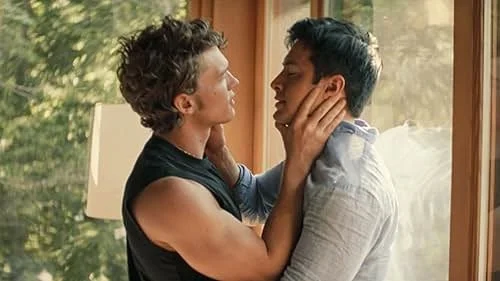
Shane and Ilya at the cottage.
At Shane's cottage, away from cameras and prying eyes, they cuddle under a blanket on the dock as the sun sets. Ilya lays with his head in Shane's lap in front of a fire pit, telling Shane his secrets as Shane runs his hand through Ilya's curly hair. Throughout this final episode of the first season, Shane and Ilya are almost always touching each other: a hand on a thigh, a kiss on the cheek.
Though Shane and Ilya take literal years to say what they mean to each other, they communicate heavily through looks and touch, tone of voice. Intimacy is a whole other language rarely employed so deftly, and almost never seen on television in the West about queer people. Though Hollywood would probably bristle at the allegation, the American entertainment industry is way behind much of the rest of the world when it comes to queer representation. There are literally hundreds of nuanced, diverse, poignant, sexy queer love stories put out every year in Thailand, Taiwan, Japan, Korea, the Phillippines, and even mainland China. (Ask me if you want recs. I keep a running list.) The UK has produced important queer teen stories in Heartstopper and Skins, while Norway gifted us with the beautiful SKAM and Sweden gave us Young Royals. If you are willing to read subtitles and maybe pay for an extra streaming service, you can have access to a wide variety of these stories for a nominal fee.
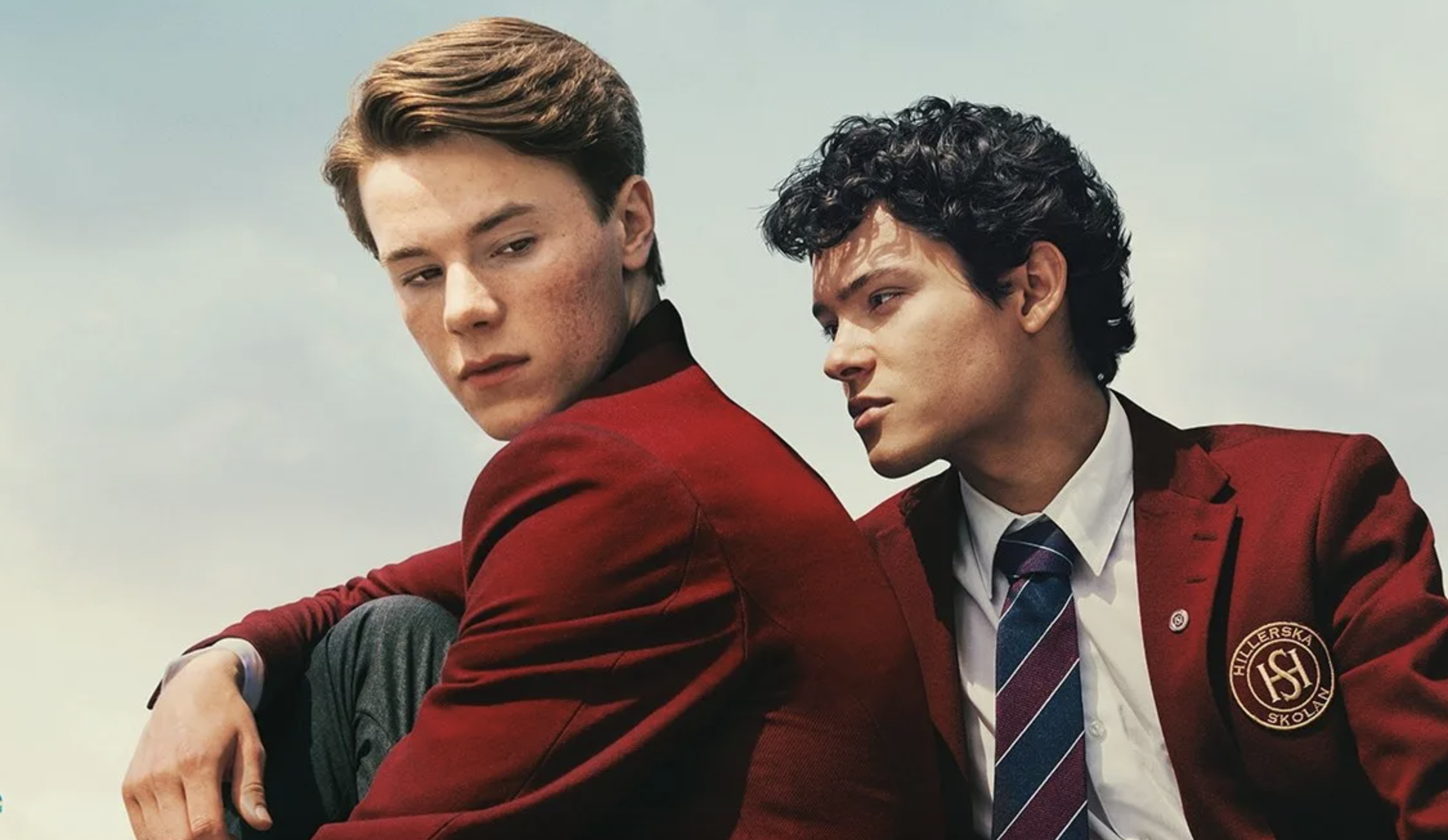
Simon and Wilhelm in Sweden’sYoung Royals.
But in North America, generally speaking, we do not have this kind of abundance. Yes, there are shows with queer characters, and some are done very well. This year alone we got Overcompensating, a raucous comedy that centers around a former high school football player who is coming to terms with his sexuality in college, and Boots, a show that follows a gay teenager as he tackles Marine boot camp. They are both good, and contain a specific type of representation that we don't see often, if ever.
These shows, however, are not concerned with queer intimacy the way Jacob Tierney—Heated Rivalry's gay show runner—is. What he produced, along with mostly-unknown actors Connor Storrie and Hudson Williams, is one of the sweetest, gentlest, most tender love stories I have seen in a very long time. It is a story that feels real while also using conventions of romantic fantasy, but never, ever makes fun of them. It's earnest, it's smart, it's unapologetically queer.
For all those seeking a reason for why this show has resonated so deeply, consider the ways in which this is also a story of opening up, of liberation, of truth-telling. Shane and Ilya begin as teenage rookies whose worlds have been defined and limited by hockey and the culture that surrounds it. Ilya's Russian upbringing has made him wary of being open about his queerness, while Shane seems to think his desires will make others unhappy with him. Shane and Ilya's primary obstacles lie in their own emotional barriers and an outside world that they are not sure will embrace them should they go public, but neither of these things defeat their quest for intimacy and safety in each other. As they move through the years of their relationship, they slowly awaken to a larger world. They gain friends who see who they are and love them, they watch another hockey player come out publicly, they learn how to talk to each other about what they feel.They are able to preserve their own space to be themselves, to find a way to be together, and to re-write the rivalry narrative that has shaped their public images. Unlike their spiritual predeccesors Ennis and Jack (Brokeback Mountain), they claim their own agency and create a future where they can be together.
This is exceptional for a queer love story. All too often, onscreen queer relationships are ruined by bigotry, violence, or simply other people's wishes and opinions. Coming out is milked for dramatic purposes, and queer stories are weighted down with explanatory commas to make them palatable for straight audiences.
Coming out stories are mostly uninteresting to me, to be honest, especially because anyone who is queer knows that coming out is a continuous process, not a single event that makes for a solid story beat. What I look for in queer entertainment is coming in - to community, to your own sense of self, to the magical feeling that is belonging. This is ultimately what Shane and Ilya give each other.
I work in marketing, and I can tell you that no matter how good something is, most of what makes something go viral isn't its quality or even how well you play up its selling points. It's timing. This show hits different because it celebrates a burgeoning love between two men during a time that queer people are facing regressive politics and hate-filled rhetoric that we thought we defeated years ago. Every time I read the news, I think of the way in which our politics are attempting to constrict our world—to ban books, to make it impossible to teach about the truth because it's uncomfortable, to limit medical services for queer people, to erase all evidence of queer history. Amidst this rampant narrow-mindedness and attempts at erasure, Heated Rivalry asserts that queer people exist and love each other always, even in the most heteronormative, homophobic places. You can be raised in Russia and play the one professional sport where no player has ever come out, but at the end of the day you are who you are. You love who you love, and that love wins. Period.
It is rare to find a show creator who cares as deeply about quiet moments of queer intimacy as Tierney does, who believes that you can hold an audience's attention with tenderness as easily as you can with explosions. I hope maybe the success of this show will allow for more "quiet" queer shows and books, for the types of stories that frame queer love and intimacy as beautiful and desirable. I can't pretend I know how to solve the world's problems, but I have to believe that giving queer people happy endings is a start.